
The post Eek! Discover 3 Bugs That Survive In and Under Human Skin appeared first on A-Z Animals.
It’s disgusting, but some creatures can survive on and under human skin! One is and insect and the two others are worms transmitted through fly bites; so, insects are the culprits in all three cases. It’s essential to understand how they live and spread, especially if you’re in regions where they’re common. So, what pests are bold enough to “colonize” our bodies? Keep reading to find out! We’ll tell you how they look, how they are transmitted, where they are located, and who’s at a high risk of infection!
This post was updated on October 21, 2025 to clarify link to cleanliness regarding lice, that pubic lice infect all sexes, how long the loa loa can survive subcutaneously, typical treatment of loa loa, and details regarding Onchocerca volvulus.
1. Lice
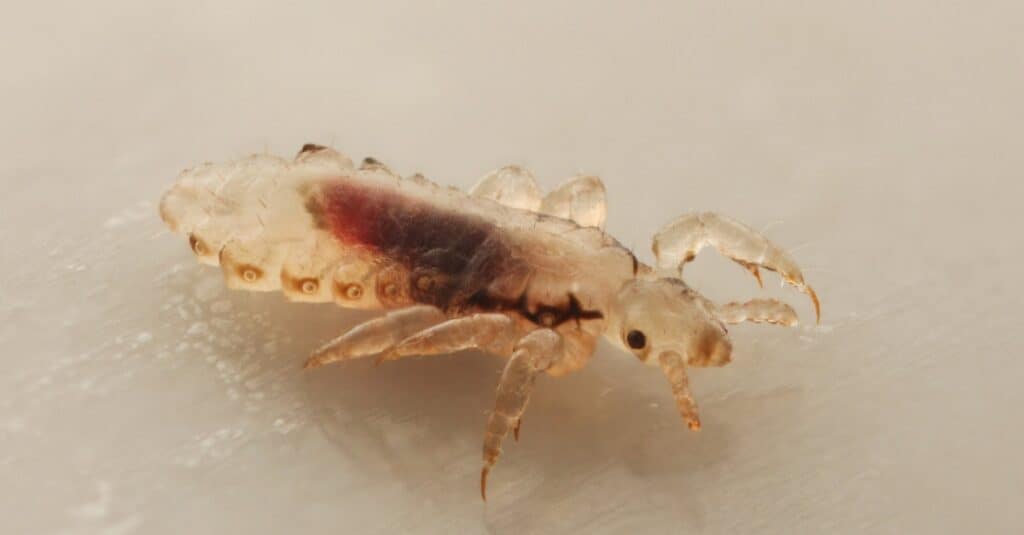
The term “louse” is used to refer to any of the 5,000 species in the
Phthirapteraorder.
©iStock.com/DeVil79
| Lice | |
|---|---|
| Scientific name | Phthiraptera (order) |
| Species parasitizing humans | The head louse, the body louse, and the pubic louse |
| Transmission | Close contact with an infected person |
| Survival method | Lice feed on human blood |
| Location on the human body | Scalp, pubic hair, perianal area, and eyelashes |
The term “louse” (or its plural, “lice”) is used to refer to any of the 5,000 species in the Phthiraptera order. These parasitic insects live on warm-blooded hosts among hairs and feathers. There are two types of lice: chewing lice, which feed on skin and debris, and sucking lice, which feed on their host’s blood.
Humans can get infected with three types of sucking lice: head lice, body lice, and pubic lice. While head lice are not related to hygiene or cleanliness (they spread mainly via head-to-head contact), body lice are associated with poor hygiene/overcrowding and can transmit disease.
Head lice live on the human scalp and feed on the host’s blood. They do not infect any other living creature besides humans. Head lice aren’t believed to transmit diseases, although their bites can cause secondary infections. These insects are very small, measuring approximately 0.09 – 0.11 inches long.
Body lice do not live on a human’s body. Instead, they settle on human pieces of clothing and “visit” their hosts only when they need to feed. They will cause numerous itching bites on the body that can, in turn, lead to secondary infections. Symptoms of severe and long-term infestation include lethargy, fatigue, and apathy. Moreover, body lice can transmit other diseases, too, including epidemic typhus, trench fever, and louse-borne relapsing fever.
Pubic lice are also called crab lice. While they primarily inhabit a human’s pubic hair, crab lice can also be found in the perianal area and children’s eyelashes. Pubic lice infect all sexes. The main crab lice infection symptom is itching that becomes stronger and stronger. Fortunately, crab lice are not believed to transmit diseases, unlike body lice.
2. Loa Loa Worms
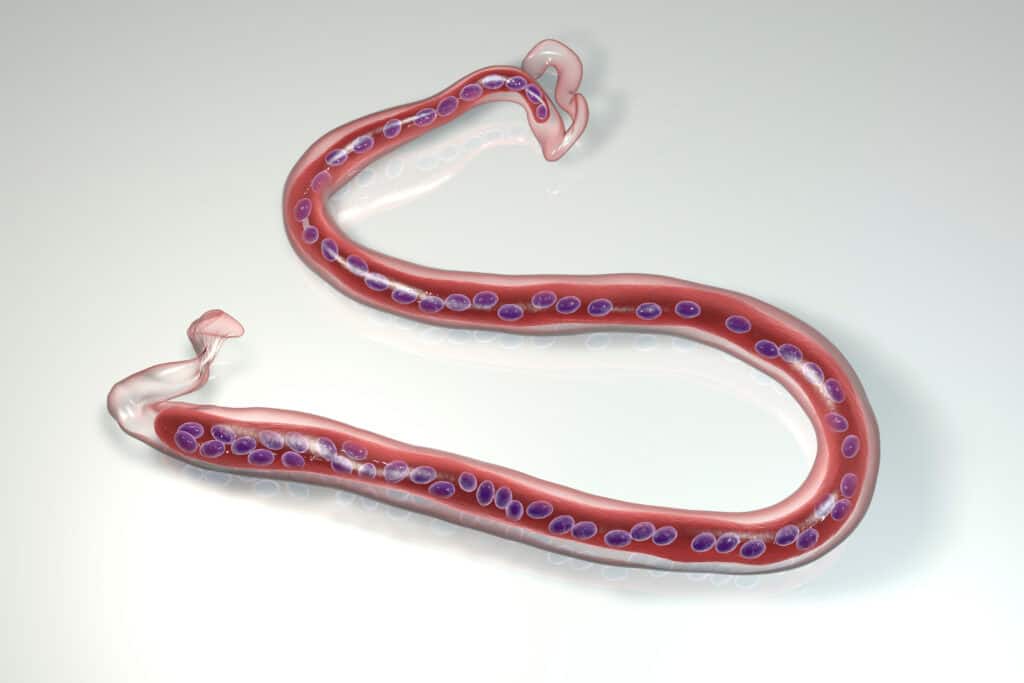
Loa loa nematodes are also known as eye worms; they cause the disease called Loa loa filariasis.
©Kateryna Kon/Shutterstock.com
| Loa Loa Worms | |
|---|---|
| Scientific name | Loa loa |
| Disease name | Loa loa filariasis |
| Transmission | Through deer fly insect bite |
| Location on the human body | Eyes, bridge nose, kidneys, heart, nipples, penis, and testes |
Loa loa nematodes are also known as eye worms; they cause Loa loa filariasis. These worms grow up to 2.75 inches long and complete their life cycle on a human’s body. Transmission occurs through the bite of a deer fly. People in the West or Central African rainforests are at great risk of getting Loa loa worms, especially during rainy days.
Though Loa loa resides primarily subcutaneously for years, the adult worm migrates transiently under the conjunctiva (for hours–days when observed). The worms sometimes end up in the subconjunctival eye tissues. Luckily, eye worms do not usually interfere with their hosts’ vision but can cause pain if they move on the eyeball or cross the nose bridge to get to the other eye (eek!). In rare cases, they can also inhabit the kidneys, the heart, the nipples, the penis, the testes, and the nose bridge, where they’re more difficult to notice.
It takes around five months for the larvae to become adult worms in a human’s body, so symptoms may appear months after infestation. They can live in a human host for up to 17 years!
The main symptoms are the Calabar swellings, often located near the joints, which can be painful. Moreover, dead worms can cause chronic abscesses and eventually lead to granulomatous reactions (chronic inflammations) and fibrosis (thickening or scarring of lung tissue).
Even though the infection with Loa loa nematodes is generally considered safe (with the exceptions listed above), the treatment is complex. First-line drug is diethylcarbamazine (DEC); surgical extraction is sometimes performed for migrating adults in the eye/skin. Ivermectin is used cautiously (risk of severe adverse events in high microfilarial loads)
3. Onchocerca volvulus
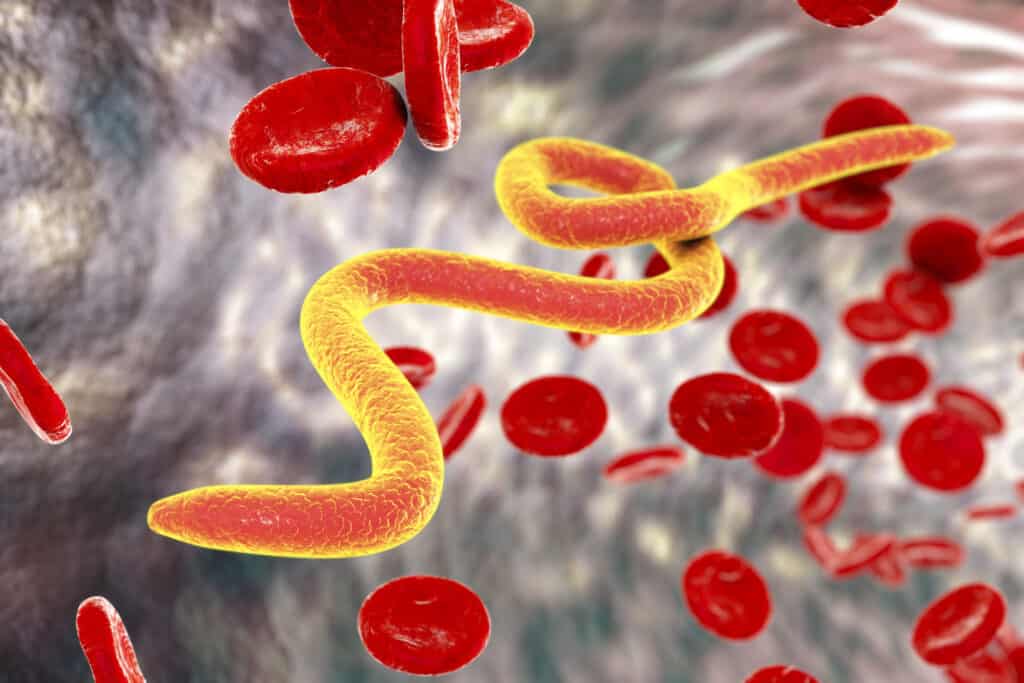
can cause onchocerciasis, also known as river blindness.
©Kateryna Kon/Shutterstock.com
| Onchocerca volvulus | |
|---|---|
| Scientific name | Onchocerca volvulus |
| Common name | A type of roundworm |
| Transmission | Through blackfly bites |
| Distribution | Sub-Saharan Africa, around streams and rivers |
Onchocerca volvulus is a type of roundworm primarily found in sub-Saharan Africa. People can get these roundworms through the bites of the female blackflies in the Simulium genus.
Male parasites measure roughly 0.9 inches in length and are much smaller than females, with an average length of 9 to 27.5 inches! They are most commonly found around streams and rivers. Infective larvae are deposited by the fly and develop to adults in subcutaneous tissues, forming nodules (onchocercomas). These microfilariae that migrate through skin and eyes cause itching, dermatitis, and eye disease.
Unfortunately, the infections caused by these worms are much more serious than the ones previously mentioned. Onchocerca volvulus can cause onchocerciasis, also known as river blindness. This disease causes severe itching and bumps under the skin. If the infection is severe, it can lead to keratitis (inflammation of the cornea) and blindness. It’s believed that river blindness is the second-most common cause of blindness attributed to an infection.
Ivermectin remains the cornerstone of control (kills microfilariae; embryostatic on adults). Reports of suboptimal responses exist, but definitive widespread resistance is not established. Moxidectin, which was approved for treatment more recently, can suppress microfilariae longer in some settings.
In 2023, roughly 249.5 million people required preventive treatment for this disease. Estimates include about 14.6 million with skin disease and 1.15 million with vision loss.
Summary of 3 Bugs That Live in and Under Human Skin
| Name | Transmitted By | Possible Diseases |
|---|---|---|
| Louse | Nearness to an infected person | Head lice – none; Body lice – typhus, relapsing fever, trench fever; Pubic lice – severe itching. |
| Loa Loa Worm | Deer fly bites | Swellings, lymphatic edema, abscesses, granulomatous reactions, or fibrosis. |
| Onchocerca volvulus | Blackfly bites | Severe itching, bumps, keratitis, blindness. |
The post Eek! Discover 3 Bugs That Survive In and Under Human Skin appeared first on A-Z Animals.
October 21, 2025 at 05:32PMJeremiah Wright.jpeg)


.jpeg)

0 Comments