
The post How Do Snakes Poop? Snake Digestion, Explained appeared first on A-Z Animals.
Watching a snake poop may not be everyone’s idea of fun, but it can tell us a lot about snake digestion, which is a fascinating subject. In this extraordinary Instagram post, a snake is taking a poop, which gives us an idea about how waste gets out of their body. However, the clip also raises a few questions. How does snake digestion work? How often do they poop? Should their poop look like this? Read on to get the answers to these and many other snake poop-related questions.
Snake Diet and Digestion
A snake’s precise diet will vary by species, but they all have two things in common. They are all carnivores, and they all swallow their prey whole. Some eat warm-blooded prey (such as rodents, larger mammals, and birds), others eat reptiles, insects, amphibians, eggs, fish, worms, or slugs.
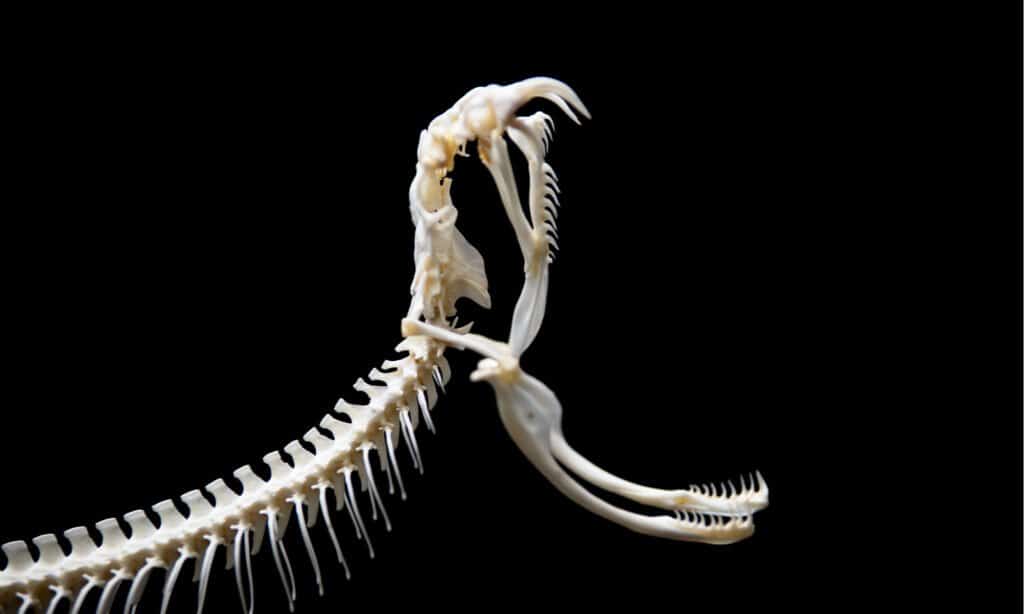
Thanks to the design of their ‘walking jaw’, they can swallow even larger prey whole. This is necessary because snakes lack the mouth structure and teeth needed to chew or tear pieces off their prey. The two halves of the jaw can operate separately to swallow the prey headfirst. Their curved fangs dig deeper into the prey if it is still alive and tries to escape. Then the prey enters the snake’s digestive system, and things get really interesting!
Entering the Snake’s Digestive Tract
Snake don’t unhinge or dislocate their jaws. Instead, their jaws are connected with stretchy ligaments so they can open wide.
©David Herraez Calzada/Shutterstock.com
Many snakes are infrequent feeders. Burmese python, for example, can go a month or two without eating if they have had a large meal, but it is usually a week or so. When they are resting between meals, their metabolism slows and blood is diverted away from their digestive system, so it reduces in size. When they are ready to feed, their metabolism fires up and their heart and circulatory system pump more blood to the digestive system, which boosts its size.
Broadly speaking, snakes have a similar digestive tract to us and many other species. From the mouth, the food enters the esophagus and then the stomach. Here, a mixture of hydrochloric acid and digestive enzymes breaks it down. It takes just a few hours for the pH to drop to 1.5. The process is helped by strong stomach muscles churning the food around (mechanical digestion). Importantly, the food stays here for as long as a week or even more! Your stomach is just as acidic as a snake’s, but you only keep your food there for a few hours. Spending over a week at a pH of 1.5 is enough to break down most organic matter, even bone. The only things that remain intact after a snake’s digestive process are hair and claws.
Moving on to the Intestines
The now liquified stomach contents then move into the small intestine, where digestive enzymes produced by the pancreas and gallbladder break the food down further. Unsurprisingly, given the snake’s body shape, both the stomach and intestine are long and narrow organs. Thanks to the increased blood supply, the intestinal walls are thickened and absorb the nutrients from the food into the blood.
The Fascinating Details of Snake Poop
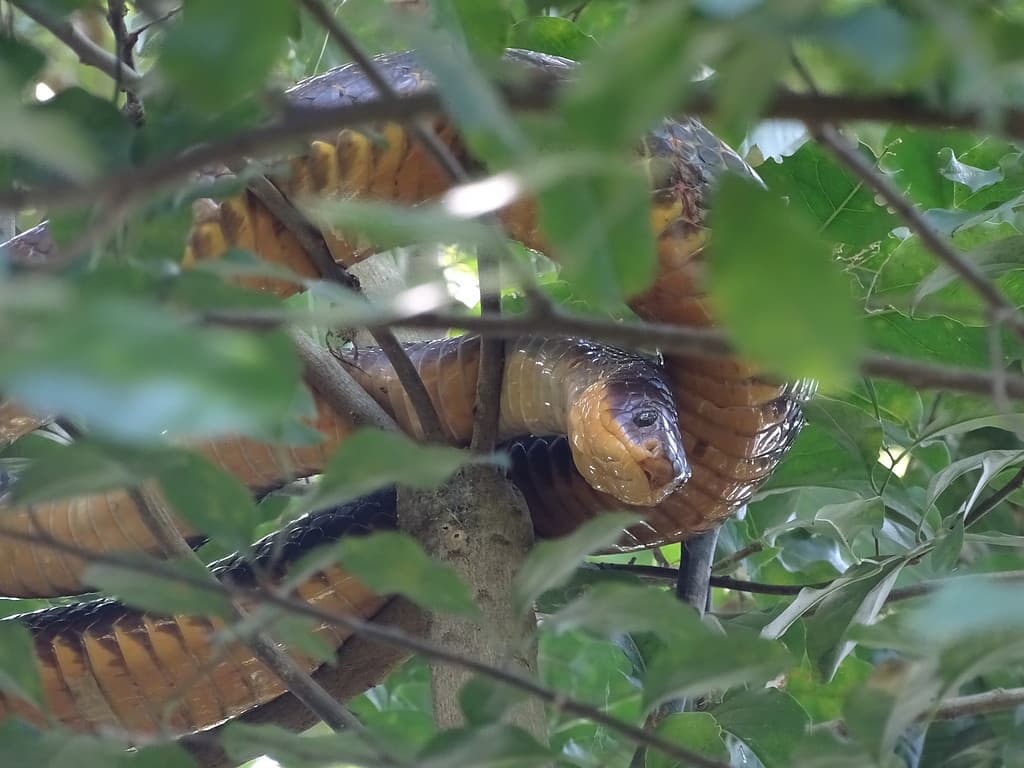
Arboreal snakes poop more often because they need to be mobile.
©Nico Priewe/iStock via Getty Images
Anything left after digestion is excreted through an anal opening called a cloaca. This is found at the end of their belly at the beginning of the tail. Unlike in mammals, this orifice does not just empty the rectum (end of the digestive tract). It is also where uric waste is excreted, where they mate, and where eggs are laid.
Snake pooping behavior is highly variable! For example, rat snakes defecate every two days, but bush vipers do so every three to seven days. Larger snakes typically eat less frequently and poop less frequently, but the poops is larger. Some snakes have been known to only poop a few times a year! Therefore, between 5 and 20 percent of a snake’s body weight can be made up of poop.
Arboreal snakes, which live in trees, need to become mobile quite quickly after eating, so they pass their poop quite quickly. Snakes that live on the ground (called terrestrial snakes) can hold onto their poop for longer. Some experts think that they even do this to make them heavier for when they attack their next meal! This means that when a snake takes a poop, it is often the last but one meal that is coming out.
What Does Snake Poop Look Like?
So that brings us to the topic of snake poop appearance. Does all snake poop look like the one in the above clip? The answer is no, it does not.
Snake poop in the wild looks very similar to bird droppings. It has dark brown or black bits with a white, chalky substance smeared over it. The white bits are urates – it’s a bit like solid urine and also comes out of the cloaca, so it gets mixed in with the poop. Birds also have a cloaca, and this is why snake and bird poop look a little similar. Snake poops are called pellets.
Most snakes eat mammals, so if you look closely, you may see fur, partially digested bones, and even teeth. There will be no plant fibers because snakes do not eat vegetables or vegetation.
Pet Snake Poop

Pet snakes generally have a more regular diet.
©iStock.com/Vagengeym_Elena
Pet snake owners must get used to examining their snake’s poop because it is a good indicator of their health. Also, snakes kept as pets tend to have a more regular diet, so their poop should not vary much from week to week. If you are feeding mice or rats to your pet snake, it will not be unusual for you to see fragments of bone in their pellets. Any sudden changes in their poop should be discussed with a vet specializing in reptile care. Collect a sample of the poop to take with you.
In general, healthy snake poop is firm and well-shaped. Health issues can cause runny and watery poop. However, loose and unformed stools may be normal for some snake species and individuals. Diarrhea in reptiles can be a sign of an infection caused by bacteria, a virus, or a protozoan. It can also indicate a chronic condition such as gastrointestinal ulceration. An inappropriate diet or improper temperature regulation can also cause diarrhea in snakes. Other possible factors are stress, toxin ingestion, foreign body obstruction, and tumors.
The Downside of Snake Digestion
Snakes have evolved their digestive methods to allow them to survive in the ecological niche that they inhabit. However, there are some downsides and risks associated with their digestion strategies. Taking weeks to digest your food may result in little waste, but it uses up a lot of energy. The snake’s body has to make a lot of acid and enzymes, and their muscles have to work hard to churn the food up. Some studies have estimated that pythons use up to half the energy generated by each meal to actually digest it due to the high metabolic demands.
When it has eaten a meal, especially if it is a big one, the snake can hardly move. This makes it very vulnerable to predators. In very dangerous situations, snakes have been known to vomit what they have just eaten so that they can make their escape.
Eating an entire animal is also not without risk. Hard structures such as horns can pierce a snake’s internal organs. Others have died because they tried to swallow something that was simply too big for them to get down their throat.
Putrefaction is also a significant danger. If the dead prey begins to rot inside the snake, decomposition bacteria can cause bloating and potentially rupture the digestive system. Digestion is, therefore, a race against time for the snake. Snakes try to keep themselves warm because higher temperatures speed up digestion. This is why you may see some snakes sunbathing before hunting a large meal—they are preparing their bodies to digest it more efficiently. Also, venomous snakes use their venom to start off the digestion process, which cuts down on the energy they have to use to digest the prey.
The post How Do Snakes Poop? Snake Digestion, Explained appeared first on A-Z Animals.
November 25, 2025 at 06:02PMSharon Parry.jpeg)


.jpeg)

0 Comments