

The post This Mantis Attack Shows Why Wasps Stand No Chance appeared first on A-Z Animals.
Mantises are one of the most efficient hunters in the animal kingdom. Between their ambush skills and camouflage, not to mention the speed with which they strike, many targeted insects do not know they are in danger until it is too late.
Wasps are also formidable creatures. Their venomous sting and ability to sting multiple times make them dangerous flying insects. Wasps use their stinger both to defend themselves and to immobilize prey, making for an easy meal.
However, when it comes to a mantis versus a wasp, it is a total takedown. While wasps can sting mantises, they generally do not get the opportunity, given the stealth with which mantises attack, as seen in an Instagram video of a mantis defeating a wasp.
A Mantis Takes Down a Wasp and Makes It Look Easy
A mantis easily captures and consumes a wasp in captivity.
© – Original
Praying mantises are dangerous predators in the insect world. They are capable of ambushing everything from caterpillars to crickets, butterflies, beetles, spiders, and even small lizards and frogs. Given that these creatures are taken by surprise and some have no defenses against capture, it is a one-sided fight.
Surprisingly, odds generally fall in favor of mantises when they snare a wasp. This was seen in an Instagram video in which a mantis is presented with a wasp. The wasp makes a bold attempt to escape. But, unfortunately, for the wasp, it was to no avail.
An Instagram video was posted by @explaininginsects to show the truth about whether a mantis or wasp would prove to be victorious when in a fight for their lives. A wasp was put near the clutches of the mantis. Initially, it looked like the wasp was going to be handed to the mantis as a snack. However, the wasp attempts to fight back and fly off.
The mantis grabs the wasp a few times and seemingly slams it against the surface of the Styrofoam wall to subdue it. This is enough to stop the wasp from flying. The mantis then grabs the wasp and begins to methodically take the wasp apart while beginning to eat it at the same time.
The wasp can be seen attempting to sting the mantis. If the stinger could get to the mantis, it would inject the mantis with venom and stop the attack. However, the mantis keeps the abdomen region of the wasp still and far enough away so that stinging is not possible.
In the end, the mantis easily defeats the wasp, despite the wasp having stinging capabilities to defend itself.
How Mantises Kill Wasps
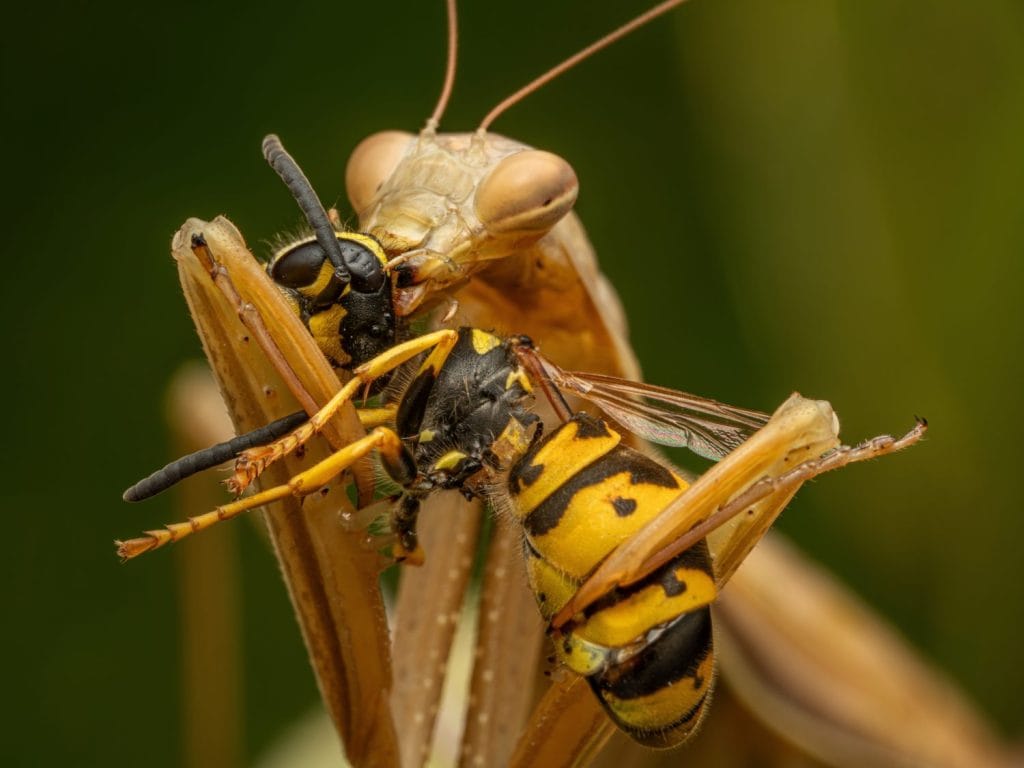
Mantises will ambush wasps and then use their raptorial legs to immobilize wasps, while they begin to consume them.
©Szabadi Jeno Tibor/Shutterstock.com
The video shows that once the mantis has the wasp in its grasp, the wasp is not going anywhere. This is because the mantis is specially designed with little barbs that keep wasps and other creatures from escaping.
While they may not look like much to the human eye, mantises have sharp spines on their legs. Their legs are known as raptorial legs. When a mantis ambushes a wasp, it will press these spines into the wasp to keep it immobile.
In the case of the wasp, this is very important, as the stinger contains venom. While one sting would likely not kill a mantis, it would be enough to make the mantis think twice about letting the wasp go.
As the mantis is keeping the wasp still, it will begin to break the wasp into smaller pieces. This helps to both ensure the wasp will not escape and to make the wasp a smaller meal, as mantises cannot consume a wasp in one bite. In the case of wasps, specifically, mantises target the muscles that allow them to fly first when eating. This, again, helps with immobilization. However, it is also said that mantises prefer this portion of the wasp over the rest of its body.
The mantis will begin eating the wasp while it is still alive. It will consume everything except for the toughest parts of the wasp’s body. While mantises can defeat wasps, doing so takes a lot of energy from the mantises. That is why, if other prey is available, mantises would prefer to go after something else instead.
Mantises Have Been Known to Snatch Wasps From Wasp Nests
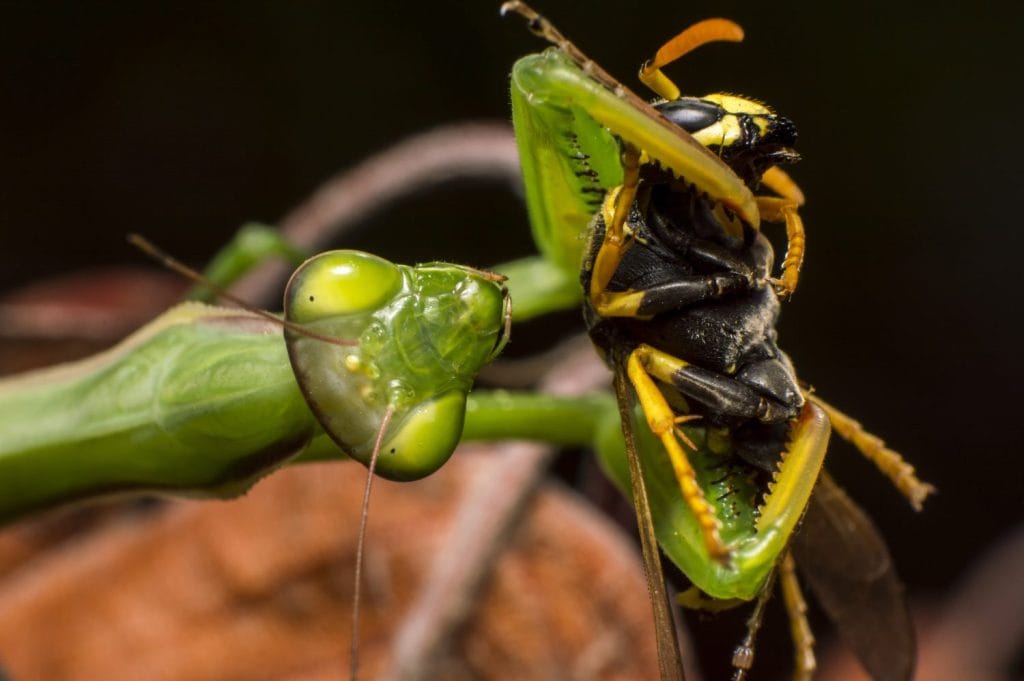
When a mantis targets a wasp nest, the outcome for the mantis can be unpredictable.
©Robert Keresztes/Shutterstock.com
Mantises are very efficient at killing wasps. That is when it is a one-on-one battle, however. When mantises make a bold decision to go after a wasp nest, the outcome of the situation is not as cut and dry.
At their peak during the summer, there can be anywhere between 3,000 and 6,000 wasps in a nest. The numbers do not deter mantises, though. Mantises will lie in wait for individual wasps to leave the nest. As they leave, the mantis will snatch the unsuspecting wasp and make a meal out of it.
Does this mean the wasps are sitting ducks? The first several that come out of the nest may be. However, as the wasps die, they emit pheromones that alert the rest of the colony to danger. Consequently, wasps will respond to the pheromones, specifically if they are near the nest. This puts the mantis in danger as the wasps will attack. Once too many wasps surround the mantis, it is the choice of the mantis to try to fight back or retreat. Those mantises who receive too many stings will ultimately perish.
Wasp Stings Can Be Deadly to Mantises

Wasps can gain the upper hand over mantises if they sting them repeatedly.
©Ruth Swan/Shutterstock.com
Unlike bees, which can sting only once before dying, wasps can sting multiple times and live. This is why, when attacking a single wasp, mantises make sure to keep the abdomen area still so they are not stung.
Mantises are not always the victors during an attack. If multiple wasps are attacking a mantis, the outcome may prove to be deadly for the mantis. It is not because of the discomfort of the stings, but because venom is injected into the mantis’ body at the same time.
Many mantises will seek shelter away from wasps if they become overwhelmed. However, if there are far too many wasps that the mantis has encountered, the wasps will not stop their attack until the mantis is dead.
Mantises and Wasps Are Both Important to Their Ecosystems

Wasps and mantises both play essential roles in the habitats they inhabit.
©I Wayan Sumatika/Shutterstock.com
Mantises and wasps are clearly enemies of one another. However, the habitats where they live require both the mantis and the wasp to thrive. This is because both mantises and wasps play an essential role within their ecosystems, which would not be the same without either.
The relationship between mantises and wasps is not symbiotic. Instead, each species helps its environment flourish by performing its natural role. In the case of the wasp, the jobs the wasp is designed to do include:
- Control the population of other insects
- Pollinator
- Scavenges dead bugs, helping with the decomposition process
Mantises, on the other hand, are pest controllers. They help maintain a healthy overall environment by controlling insect populations.
If mantises were once abundant in a habitat and then suddenly disappeared, leading to an increase in insect numbers, it could indicate that something is wrong in the ecosystem. These stealthy hunters are “indicators of environmental health.” Without them, populations become lopsided, and the habitat they once lived in can become unhealthy.
While some people do not want either wasps or mantises in their gardens, both play a role in the ecosystem. Neither wants the other in their vicinity, however, and will strike if given the opportunity. Unfortunately, for the wasp, it is generally on the losing end of that battle, given how quickly a mantis can attack without warning.
The post This Mantis Attack Shows Why Wasps Stand No Chance appeared first on A-Z Animals.
November 12, 2025 at 11:02PMJessica Tucker.jpeg)


.jpeg)

0 Comments